William the Conqueror
-
Entry #22 in project #EuropeanBios is William The Conqueror, also known as William the Bastard, and the latter title is predictably more accurate. As a result of reading this bio, I finally know what happened in 1066: William became King of England by invading and stealing it.
-
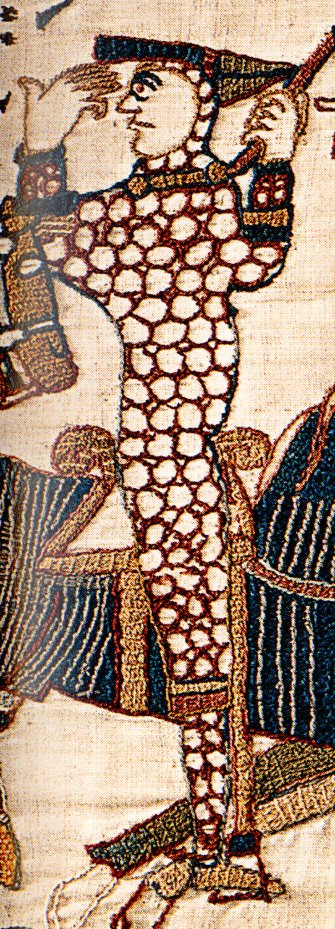
Duke William lifting his helmet at the Battle of Hastings to show that he still lives Bayeux Tapestry, c. 1070s, public domain -
Will The Bastard is related to our previous subject, Alfred The I Guess He Was Okay, by a chain of mostly very short-lived kings nearly all of whom were called "Ed", which I find stupidly amusing, so I'm going to list the chain of succession. It's my thread, I can do what I want.
-
Our friend Alfred The Great lasted 15 years, followed by Edward the Elder (25) -> Æthelstan (2) -> Edmund 1 (7) -> Eadred (9) -> Eadwig (4) -> Edgar The Peaceful (16) -> Edward the Martyr (3) -> Æthelred the Unready (38) -> Edmund Ironside (who only lasted 6 months, bless him)
-
Edmund Ironside gave way to Cnut The Great (19 years), then Harold Harefoot (5), Harthacnut (just 2) and then to Edward the Confessor for 24 years, at which point Edward fucked up by dying without a clear successor, though you'd think he could have just picked any dude called Ed.
-
If you're wondering why the endless chain of Eds was broken by a couple of Cnuts, it's because they were "Danish kings", aka Vikings, showing up and seizing power as they had from Alfred The Not That Great. This was about to happen again in the form of our friend Will Bastard.
-
See, Will was also a Viking. He was French, kinda, from Normandy. But Normandy means "Norse" and "Norse" means "Norwegian" and Norwegians were all Vikings. The Vikings had invaded northern France, and as in England they had settled in for the long haul and adopted local customs.
-
But the Vikings learning French and becoming "Normandy" was still a very recent development. It was Will's great-great-great-great grandad, a Viking called Hrólfr Ragnvaldsson, who invaded France, changed his name to "Robert", and acted like he owned the place thereafter.
-
Will was born in 1028, a mere 100 years after his ancestor created Normandy. He became king at 10 years old after his dad (also called Robert) went against all advice and joined the Crusades, where he promptly died. He at least had the sense to name Will successor before leaving.
-
Will was illegitimate (hence "bastard"), but he had backing from other nearby kings who wanted stability and so kept him on the throne until he could hold on to it by himself. But then it all went to shit in 1066 when Edward the Confessor died, leaving England's throne vacant.
-
Since there was no clear successor to England's throne a war immediately broke out. The English had a dude they liked, Harold Godwinson. Harald Hardrada, until recently king of Denmark, gave up that throne in return for military backing to try and take England.
-
Will's own hazy claim to the throne was that his great-aunt had married Athelred, a former king of England. This does not in any way make you king but he nobody else's claim was significantly less silly and he had an army so off he sailed to England to steal the whole country.
-
Thus the battle of Hastings in 1066. Harold Godwinson fended off Harald Hardrada but then got killed by Will The Bastard, who promptly renamed himself William the Conqueror and decided to dig in and really get comfortable. This turned out to be less easy than he'd hoped.
-
The British were not stoked to have been invaded and were not jazzed about William. They put up years of resistance in every corner of the country. He had to set fire to huge swathes of the countryside around London before they surrendered and let him in to be crowned.
-
And they never let up. He spent years riding around his kingdom suppressing rebellions. His tactics involved building a new kind of defensive structure never seen before in England: castles. This is why the English word "castle" is also the old Norse-French word "castel".
-
Fun fact: lots of people take the story of Robin Hood as a metaphor for the native English resistance to the illegitimate French kings in their castles. However, the original Robin Hood was in the 13th century and not a fan of any king, so this was a later evolution.
-
Most of William's reign was just violently suppressing rebellions so he could hang on to the crown. He comprehensively rooted the English out of every position of power, both in the government and the church, replacing them all with Norman-French allies he imported.
-
All of this makes modern English anti-immigration stuff even more silly. A white person in England is as likely to be an invader, either French from William's time or Viking from Alfred's, than anything else. Seems weird to be snotty about immigrants when you stole the country.
-
(At this point any Native Americans reading are more than welcome to point at the previous tweet screaming "this!!!")
-
Anyway, William The Huge Bastard died in 1087. He had three sons: he left Normandy to his eldest, called Robert; England to his second, also called William; and a pile of money to the third, called Henry. This did not work out. They immediately got into a war to control both.
-
In terms of legacy, William created the ruling class of England, all French, who held on successfully forever after that. He also ordered the creation of the Domesday Book, a statistical historical record of immense utility. But honestly I'm still laughing at all the King Eds.
- Previously: Leif Erikson
- Next: Hildegard of Bingen
- Full list
Text and images copyright © 2020-2023 Laurie Voss
except where indicated
except where indicated